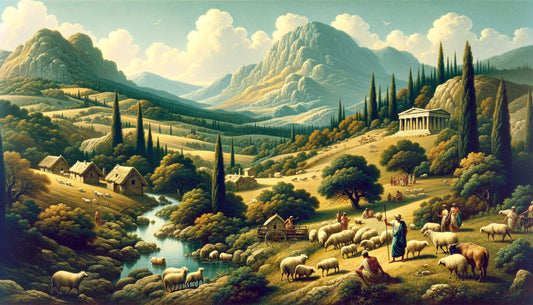

The Golden Apples of the Hesperides - Hercules' Eleventh Labour
Continuation of the story of The Cattle of Geryon.
“You still have two more labours to complete,” said Eurystheus with a serious tone.
“What?” replied Hercules, indignant. “You yourself said there would be ten, and I have completed them all!”
Eurystheus let out a faint, sly smile. Those few seconds of silence felt like an eternity. The court didn’t dare move, but everyone listened closely.
“Is it true that your nephew Iolaus helped you during the fight against the Hydra?”
Hercules was speechless. “How did he know?”
“So, you emerged victorious thanks to his crucial help!” Eurystheus continued.
“I was the one who defeated the monster!”
“And is it not also true that you accepted a reward for cleaning those filthy stables?”
“Accepted?” answered Hercules, surprised once again. “Could the two kings have spoken to each other?” he wondered. “But I never received anything for that labour!”
“So it’s all true!” Eurystheus cut him off. “Not only did you fail to fulfil your duty, but you also tried to deceive me!”
“No! That’s completely unfair! I completed the tasks exactly as I was told!”
“Watch your tone, Hercules! Remember what happened to your family. Don’t forget to respect your king and the gods! You’re here to atone for your sins. Otherwise, your soul will never be purified—do you understand?”
Eurystheus knew everything. During Hercules’ long journey back from the island of Erytheia, Hera had intervened once again and revealed those details. Together, they conspired to impose two additional labours on the hero. They couldn’t bear to see him victorious.
Rage swelled inside Hercules. He held it in, trying not to lose control. He knew that if he lashed out, all his efforts and trials might be for nothing. He bowed his head and waited for the verdict.
“Well, don’t get too comfortable. Duty calls. For your next task, you’ll go to the Garden of the Hesperides and bring me three golden apples. Intact!”
The Search for the Lost Garden
Everyone in the land had heard of the legend of the golden apples: a fruit that, if you were lucky enough to obtain it, would grant you immortality. This fruit grew in the Garden of the Hesperides, tended by beautiful nymphs, daughters of Nyx and Erebus—the goddess of the night and the god of darkness. Zeus and Hera had enjoyed it at their wedding banquet, a gift from Gaia, the goddess of the Earth. The fruit was so precious that Hera had sent Ladon, a hundred-headed dragon, to guard the tree.
And yet, although the legend was well known, no one knew where the garden actually was. Some said it lay somewhere in the north of the Mediterranean; others claimed it was west of Libya. Many rumours, but no certainty. Eurystheus and Hera knew exactly what they were doing when they assigned this labour: they wanted Hercules to wander endlessly, doomed never to find the sacred garden.
However, Hercules, no fool himself, decided to seek out the nymphs of the river Eridanus. “Perhaps mortals are blind to the hidden corners of this world, but divine creatures have other senses and deeper ties,” he thought. And he wasn’t wrong. Though the nymphs did not know the garden’s exact location, they did tell him who could guide him: Nereus, one of the Old Man of the Sea.
More than just a divinity, Nereus was older and wiser than many of the Olympian gods. He possessed the gift of prophecy and had the power to take on the shape of any living creature. That’s why it was easy for him to eavesdrop unnoticed in the most unlikely of places.
Following the nymphs’ advice, Hercules went in search of the old man—but tracking him down was no easy feat. After tracing the northern Mediterranean coast for weeks, he finally spotted an old figure sleeping on a quiet beach. He crept up silently and laid a hand on the man’s shoulder.
Startled, the old man leapt up and immediately transformed into a smooth-skinned seal. Hercules lunged forward and grabbed him tightly, not letting him escape. The old man then turned into an otter. The two wrestled on the sand—one trying to flee, the other holding fast. Nereus kept shifting forms: a tuna, a swordfish, an octopus… But Hercules clung to him with superhuman strength and refused to let go. Eventually, Nereus, exhausted, surrendered and returned to his human form: that of a white-bearded fisherman. He promised to help if Hercules let him go.
“Follow the path that runs along the great sea,” said Nereus. “Someone will call you from a high place. Help him—and he will help you in return.”
Help from the Titans
Hercules continued his journey along the Mediterranean coast, just as Nereus had advised. He extended his route to include the Black Sea, connected to the greater sea. It was there, while passing near the Caucasus Mountains, that he heard a deep and solemn voice calling from above.
“Is that you, Hercules? I have long awaited your arrival.”
Hercules looked up towards the mountain. Shielding his eyes from the sun, he saw a massive human figure chained to the rocks. He recognised him at once: Prometheus, the Titan condemned by Zeus himself to suffer an eternal punishment. Bound to the stone, an eagle devoured his liver each day; and since he was immortal, it would grow back each night. Thus, he endured an endless torment—being consumed alive.
Like everyone, Hercules knew the tale of the prisoner, but only he had the courage to raise his bow and shoot an arrow at the eagle tormenting him. He trusted that Zeus, his father, would understand this decision. He climbed to the spot and freed the Titan with ease.
“I have waited a long time for this moment. I’m deeply grateful to you, son of Zeus!”
“Don’t be too sure my father will allow you to enjoy freedom for long.”
“I will present myself before him and ask for forgiveness. I know he will grant it. And you—why do you remain bound to these labours imposed by the gods and their servants? No demonic creature has stopped you, Hercules. Flee, and start a new life—free!”
“I can’t. Not yet. I have two great labours left to complete.”
“Ah yes… your eleventh task, isn’t it? The golden apples.”
“Exactly! How do you know?”
“Words ride the wind and travel far,” he replied with a smile, offering no further explanation. “But you won’t be able to pick the apples. No mortal can. Still, I know how you might succeed.”
“Tell me.”
“My brother Atlas stands before the Garden of the Hesperides, holding up the sky. He too is serving a sentence. Go to the river Oceanus, at the far edge of the west, and convince him to help you. He’ll be able to retrieve the apples with ease.”
After stretching his legs, Prometheus bid farewell and set off for Olympus to face Zeus. Hercules, for his part, continued westward to find the Titan’s brother.
The Garden of the Hesperides
Hercules knew that there was only one way to reach the ends of the world. He approached the sea and once again asked Helios for the cup. As he had used it well the first time, the god didn’t hesitate to grant him a second opportunity.
The morning light awoke Hercules inside the cup and, just as before, he realised he was arriving at the coast of the Hesperides. Towering cliffs rose straight from the sea, merging into a storybook-like vegetation. This time, however, there was no welcoming party nor any sign of divine or human presence in that remote land. Despite the lush greenery blossoming in a secluded bay, he found a clearly marked path that led into those sacred lands.
Hercules walked for a while through an idyllic forest and continued across a series of crags that eventually opened up into a network of meadows. Following the path, he finally saw on the horizon what he had come for: the Garden of the Hesperides.
Though it had no visible entrance, it was clear when one had stepped inside. The wild grass turned into a perfectly kept lawn. Trees grew freely, without competing for space. There were fountains scattered across various corners, and the place seemed endless. And there, in the heart of the garden, stood a radiant and majestic tree… with something moving around it.
The Impossible Harvest of the Apples
It was the tree of the golden apples. Ladon, the serpentine dragon of a thousand colours, wound his way slowly up and down the trunk, coiling around it with both elegance and menace. That creature too was a child of Typhon and Echidna, and thus sibling to the Hydra that Hercules had defeated at Lerna.
The hero approached cautiously, remaining at a safe distance, hidden behind the rocks near a fountain. “Perhaps it won’t be that hard to pick the apples,” he thought. Still, he was unaware of the monster’s speed and powers. The solution would have to be a double strike.
He had his club ready, but first he took his bow and fitted one of the poisoned arrows. “Will this venom be effective on a creature of the same blood? Time to find out.” Hercules waited for the dragon to begin climbing the tree and then loosed the arrow, which struck the creature hard. The beast shrieked and began to thrash upwards in defence, but it quickly fell to the ground, writhing in fast, sinuous movements, twisting in pain.
As planned, Hercules ran beneath the tree and, without hesitation, began crushing heads with his club, one after another, until Ladon lay still. The garden’s guardian was no more.
With no other threat in sight, he decided not to waste time and went to pick the divine apples he had been tasked with retrieving. He tried and… alas! Every time he was about to touch one, the apple vanished like a mirage. Was it a trick of the eyes? No. It was as if the fruit shifted a few centimetres just as he reached for it. He tried again with the closest apples, even climbed the tree, but the sacred fruit resisted all contact with mortal hands.
At that moment, he remembered Prometheus’ words. He had to find Atlas. Only with his help could he obtain the sacred fruit.
A Game of Deceit
Hercules left the garden and made his way to the coast. At one end of the land of the Hesperides, Atlas was said to be found. And so it was. After wandering through that enchanting region all day, he finally saw the Titan in the distance: hunched over, his back arched as if bearing an immense burden.
“I don’t like being watched. Go away, whoever you are.”
“Your brother Prometheus sends his regards,” Hercules replied firmly. “I’m here because he told me only you can help me.”
“Me? What a fool you are… Can’t you see, poor wretch, the burden I carry?” Atlas muttered, raising his eyes to the sky.
“You can reach the golden apples that grow in the Garden of the Hesperides, can’t you?”
“And why should I do that? Can’t you pick them yourself?”
“I tried, but every time I reach for one, it vanishes.”
“Ah! That’s the work of the Hesperides. They only appear at sunset. But they’re there, and they’re friends of mine. I could pick the apples for you… if it weren’t for one small problem.”
“What is it? What’s the issue?”
“Can’t you see? If I let go of the sky, it’ll crush us all!”
“I can hold it while you do me this favour. That way, you can take a break.”
Hercules stepped closer and explained who he was, why he needed the apples, and how he had come this far. Only with Atlas’ help could he complete his eleventh labour and move one step closer to the redemption he longed for.
At first, Atlas doubted that Hercules had the strength to bear the firmament. Even so, he agreed to the deal and made an attempt to pass the burden to him. With great effort, Hercules took it on. Never had he felt such an overwhelming weight. He faltered for a moment, but with a few tips from the Titan, he found a position that allowed him to balance and manage the pressure of the sky on his shoulders.
As agreed, Atlas set off for the garden. Hercules watched him disappear into the distance and remained alone, focusing on his breathing, moving as little as possible to endure the strain. The minutes felt eternal. Helios had already begun to colour the sky with the hues of sunset when, at last, he spotted Atlas returning with a large basket full of golden apples.
“What a joy to see you again, Atlas! And with the apples you promised me. I’m very grateful!”
“Oh, think nothing of it! It’s been a pleasure to help you,” replied the Titan with a sly grin. “In fact, I’ve had a better idea: I’ll deliver the apples to your king myself. I’ll get there faster, and you only need to wait here.”
Hercules, no fool, immediately realised his intentions. Atlas hoped to free himself from his punishment once and for all.
“Oh, that would be most kind of you!” he replied with apparent naivety. “But before you go, let me check that I can bear the sky for that long. I need to put my cloak on my shoulder as padding. Hold it for a moment while I get comfortable.”
“Of course, I understand. This burden can be quite painful if you’re not used to it…”
When Atlas took hold of the sky again, Hercules swiftly stepped away and went for the basket. Without hesitation, he took the three apples he needed and left without looking back.
“Where are you going, liar?! Traitor! You’ve tricked me!” roared Atlas in fury, his voice echoing across the valley.
Hercules began his journey back with the three golden apples. For much of the way, he could still hear, in the distance, the Titan’s angry curses, furious at having fallen into his own trap.
The Return and the Offering
The journey back was tense and stormy: strange waves pulled at Helios’ cup, and furious winds tried to snatch the apples away into the sea. Was it the wrath of the nymphs or the forces of Olympus seeking to prevent his return? Hercules, however, kept the apples safely guarded and, with his trademark determination, managed to reach Tiryns once more.
Eurystheus was momentarily stunned upon seeing him enter. This labour had supposedly been impossible for a mortal. Therefore, Hercules could only be there to admit defeat… or so the king believed.
“Well then?” he snapped, wearing the smugness of someone who already considers himself victorious.
Hercules, standing tall and calm, unfolded the cloth he carried in his arms and revealed the sacred golden apples before the court. A profound silence fell. Eurystheus, Admete, and all the courtiers were left speechless in admiration. The king’s daughter was the first to approach, drawn by their divine glow, but her father stopped her abruptly. Without saying another word, he descended quickly from the throne to inspect the marvels up close. They were real—so real that he could scarcely believe it.
“You have fulfilled your duty, Hercules,” the king finally acknowledged. “And I, gratified, shall enjoy the reward of your labour. I shall savour one of these apples with delight!”
“Stop, your Majesty!” interrupted one of Athena’s priestesses. “A fruit of the gods can only be granted by the gods. Only with the permission of Hera or Athena should you dare to eat such a fruit.”
This response enraged the king. However, since the other priestesses confirmed their companion’s words, Eurystheus was forced to back down. The apples, therefore, were placed in Athena’s temple to await divine approval.
The next day, the apples were gone. Athena herself had returned them to the Garden of the Hesperides, where they were never meant to leave. And while Eurystheus wept in fury for losing the treasure that might have granted him eternal life, Hercules smiled in satisfaction, having successfully completed his eleventh labour.
To be continued…
Honour the Legend
The legend of the golden apples of the Hesperides is a tale of wisdom, perseverance, and cunning. In it, Hercules proves not only his strength, but also his intelligence in overcoming the deceptions of gods and titans alike. To immortalise this feat, we present this T-shirt featuring an illustration of the sacred apple tree of the Hesperides, depicted in an artistic style that evokes its divine glow and the mystery of the forbidden garden.

As we cannot provide you with a sacred piece, we do not want to sacrifice any animal for a piece of clothing. All our items are 100% cotton and made with the utmost respect for the environment. LũM always aims to respect the flora and fauna of our planet.
Thank you for your trust, and may the adventure continue!
Reading list
- Labours of Hercules. Wikipedia, the Free Encyclopedia.
- Fry, S. (2018). Heroes. Penguin Books.
- Hamiltor, E. (1942). Mythology, Timeless tales of Gods and Heroes. Little, Brown and Company.
- Graves, R. (1955). The Greek Myths. Penguin Books.