
The Cattle of Geryon - Hercules' Tenth Labour
Continuation of the story of The Girdle of Hippolyta.
“Here is the girdle,” said Hercules, letting it fall to the ground before Admete. The truth was, parting with the gift Hippolyta had given him was not easy. Yet seeing it gone might help him leave behind the torment he had endured in the land of the Amazons. Turning to the king, he added:
“I am ready to receive my tenth and final task.”
Eurystheus remained serious. He waited a moment, just in case his daughter showed any sign of displeasure at the gift. When she did not, he turned once more to the hero to deliver his next command:
“A new journey awaits you, Hercules. This time, I send you far to the west, to the remote island of Erytheia. I want you to bring me the cattle of Geryon. The entire herd!”
“So be it, Your Majesty,” replied Hercules, after pausing to reflect. “It is a long journey; I shall make preparations and set sail at dawn.”
Hercules left, deep in thought. He was well aware of the legend of Geryon and his herd: a giant with three conjoined bodies, son of the hero Chrysaor and Callirrhoe, daughter of the Titan Oceanus. Geryon possessed superhuman strength and was protected by his ferocious two-headed dog, Orthrus. As if that weren't enough, he was accompanied by one of Ares' sons, the giant Eurytion. The group guarded a very valuable herd due to their uniqueness: cattle with a striking red hide, revered for their rarity and splendour.
Such a voyage would carry him to the very edge of the known world—a journey as dangerous as the battle that awaited him upon arrival.
The Nightmare Towards the West
The loss of most of the crew during the previous voyage left the hero with little room to manoeuvre. Given the enormous distance he had to cover, travelling overland seemed the wisest option. So, he asked his sailors to accompany him on the first leg of the journey as far as North Africa. Once disembarked on the coast of what is now Libya, he managed to buy a camel. With that small aid, he felt bold enough to face the desert crossing.
But those deserts felt endless. The sun blazed mercilessly, and the scorching air shimmered above the sand. It was no climate to wear his lion-skin armour, which he kept for battle. The days went by, and nothing changed. The camel, who had been a great companion against solitude and dehydration, also began to falter.
At that moment of uncertainty, despair took hold of Hercules. He grabbed one of his arrows, still tipped with the Hydra’s venom, and raised his eyes to aim at the sun.
“Helios, god of the sun, I’ll drive you from the sky!” he cried out. “And if you refuse, I have enough arrows to bring you down from your chariot!”
“Stop! Don’t shoot!” replied the god in a booming voice that filled the heavens.
“Then help me—now or never!” shouted Hercules.
Though immortal, Helios feared the pain those arrows could cause him. He promised to help, asking Hercules to wait for him at the shore by sunset. Hercules agreed, and he and the camel made one final effort to reach the sea. When the god appeared with the golden light of dusk, radiant in form and mighty in voice, he handed him his great golden cup.
“Take it, son of Zeus. With it, you may cross the ocean and reach Erytheia. Follow the path of my setting light and you’ll find the way.”
Legend says that Helios would rest inside that cup during the night. It was large enough to sail like a boat and carried him from west to east along the River Ocean, allowing him to resume his celestial journey at dawn.
Before departing, Hercules stroked the camel and thanked him with an embrace around the neck. The animal returned the gesture with affection. There, they said their goodbyes. The hero then placed the cup in the water, climbed aboard, and let the divine vessel carry him across the dark waters, following the trail of the setting sun.
The Pillars of Hercules
The cup moved at breakneck speed. From inside, Hercules could see little, but he felt the glow of the sunset fading as the divine vessel gradually slowed down. When he stood up to look towards the horizon, he found himself before an immense wall of stone that blocked the waters of the sea. The sun’s light—his guiding beacon—was slipping behind that natural barrier, preventing him from continuing.
Without a second thought, Hercules leapt from the cup onto the rock. Once on top, he searched for a crevice wide enough to fit his body. Placing his arms on either side, he summoned all his strength and began to push until the stone began to crack. The hardest part was done. He kept pushing, alternating pressure from side to side, until he had opened a wide enough passage for the water to flow through.
In this way, the Mediterranean Sea became connected to the Atlantic Ocean. Thus were born the so-called Pillars of Hercules—what we now know as the Strait of Gibraltar.
When the task was done, the hero climbed back into the cup to resume his journey. Now, at last, he could venture into the ocean, towards unknown horizons.
The Remote Island of Erytheia
The sun began to rise on a new day. Light and a distant sound woke Hercules from a deep sleep—the best rest he’d had in weeks. As he sat up, he realised the golden cup was nearing the shores of Erytheia. What a relief after such an ordeal, he thought.
The sound grew clearer: it was the barking of Orthrus, the savage two-headed dog. Upon spotting the cup approaching from the sea, the beast became agitated, running back and forth while barking incessantly.
Hercules gripped his club and prepared to launch a surprise attack. As soon as the cup came to a halt in the sand, he stepped forward and, using the rim for momentum, leapt into the air. Raising his club high with both hands, he brought it down forcefully, crushing one of the dog’s heads before it had time to react.
“Cursed creature! I’m the one who slew your sister, the Hydra. And see this pelt I wear? It belonged to your own offspring. Now it’s your turn to vanish!”
Orthrus, dazed by the blow, managed to rise. The remaining head became aware of the loss of the other. But before it could lunge at the hero, Hercules was already upon it again, smashing the club into its snarling face to finish the job.
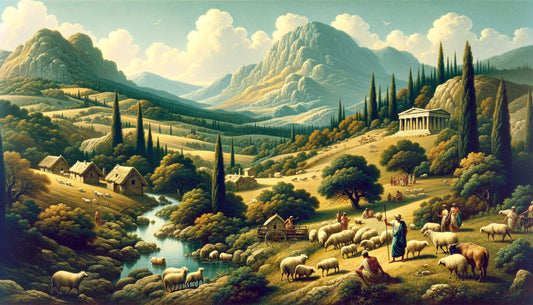
As silence returned to the island, Hercules lifted his gaze and allowed himself a brief moment to admire the island’s beauty. It looked like a slice of paradise. In the distance, he could see a large herd grazing in the fields: Gerion’s cattle, their reddish coats standing out against the lush green grass.
But a large figure was fast approaching Hercules—it was the herdsman Eurytion.
The Battle with Geryon, the Three-Body Giant
“What the bloody hell do you think you’re doing, you oaf?” shouted Eurytion, charging faster and faster towards the hero. “You’ve killed my beloved dog!”
Hercules quickly drew one of his poisoned arrows and aimed it at the giant, now only a few metres away. His sheer size allowed him to cover great distance with each stride. Without hesitation, Hercules released the arrow—straight to the neck.
A sharp thud echoed at the moment of impact. The giant let out a strangled cry before collapsing to the ground. In the blink of an eye, Eurytion lay lifeless. Despite the success of the strike, the shepherd’s final shout had echoed through the valley, and Hercules feared Geryon would soon arrive.
Still, he rushed to the meadows. Perhaps, if he moved swiftly and Geryon wasn’t nearby, he could gather the herd and make off with them unnoticed. But as he began herding the cattle, the ground started to tremble rhythmically beneath his feet.
Few mortals had ever laid eyes on Geryon—the giant with three bodies and three heads. Now, he was emerging from the valley.
“Who is this stranger who dares approach my herd?” he bellowed with a slow, thunderous voice. “How did you get past my shepherd and his hound?”
“I am Hercules, son of Zeus and Alcmene,” the hero replied with a firm voice. “And I’ve sent your cursed beasts straight to the Underworld!”
“You’ll pay for such insolence with your life!” Geryon roared, his eyes glowing with rage.
He seized his weapons—three spears, three shields, and three swords. His three bodies moved in perfect unison, as though they were one being. Hercules stood still, silent, raising his club and meeting the giant’s gaze. Geryon charged.
The clash was brutal. Hercules dodged the spears with agility, but in close combat, he had to parry three swords aiming to slice him in half. His club was strong enough to deflect some blows and push the giant back, but finding an opening to counterattack was nearly impossible. When one did appear, he struck hard, only to be blocked by another sword or shield. The lion’s pelt saved him from more than one fatal slash.
Realising he couldn’t defeat the giant in direct combat, Hercules created distance to prepare a different attack. Geryon laughed wickedly, believing the hero was retreating in fear. That arrogant grin would be his downfall.
In a swift and precise movement, Hercules grabbed his bow, notched a poisoned arrow, and—rolling across the ground—fired straight into the joint where the three bodies merged.
Geryon fell silent as the arrow struck. The Hydra’s venom quickly spread through all three torsos, and agony overtook the giant. His legs buckled; he dropped to his knees and let his weapons fall. The three heads screamed in pain as the massive body writhed across the ground. One by one, the cries faded. Geryon was no more.
Hercules stood still for a moment, gazing at the fallen giant. It had been a mighty battle, and he felt compelled to honour his fallen opponent. Once he had paid his respects, he returned to the pasture to gather the herd and guide them to the coast. There, he would use the golden cup once more to transport them across the sea.
The Return with the Herd
Helios’ golden cup was vast, but not large enough to carry the entire herd of cattle in one go. The journey was far from easy. Thanks to the divine vessel, Hercules was able to make several trips from the island of Erytheia to the mainland, arriving at the Iberian Peninsula. With each journey, he transported part of the herd.
“My cup has carried you to safety, son of Zeus!” proclaimed Helios with an omnipresent voice. “You have succeeded. It is time for me to reclaim my vessel.”
“Of course,” replied Hercules. “I thank you from the bottom of my heart. I truly don’t know how I would have managed without it.”
“Your determination is admirable. Go now with fortune, and may no mortal or divine force ever steer you from your path.”
The return journey was long and full of obstacles. Such an extraordinary herd did not go unnoticed, and more than one thief attempted to steal some of the beasts. As always, Hera watched Hercules’ progress from Olympus. Infuriated by the hero’s continued success, she prepared once more to intervene.
After a year of travel, Hercules finally returned to Tiryns with the cattle. He was exhausted from the journey, but the mission was complete, and he felt, at least in part, fulfilled.
“Are you sure these beasts aren’t cursed?” asked Eurystheus, eyeing the animals suspiciously. “With that reddish coat, they look like creatures from the Underworld!”
“No, majesty. They’re simply unique animals. You have no idea how many tried to steal them from me along the way.”
“In that case,” continued the king slyly, “they are worthy of a great sacrifice to the gods. It shall be in Hera’s honour, to protect the royal family. A fine idea, wouldn’t you say?”
Hercules couldn’t believe what he was hearing. After all that hardship, those magnificent bulls were to be sacrificed? But exhausted and worn down, he didn’t resist.
“So be it, majesty. In any case, I have completed my tenth and final labour. I have atoned for my great wrongdoing, and I ask that my freedom be returned to me.”
“Not so fast, Hercules!” Eurystheus cried, with a wicked grin.
Continues with The Golden Apples of the Hesperides.
Honour the Legend
The legend of Geryon’s cattle is a journey of effort and determination that takes Hercules to the very edge of the known West. To immortalise this feat, we present this T-shirt featuring Geryon’s majestic bulls, depicted in an artistic style that captures their strength, beauty, and legendary spirit.

As we cannot provide you with a sacred piece, we do not want to sacrifice any animal for a piece of clothing. All our items are 100% cotton and made with the utmost respect for the environment. LũM always aims to respect the flora and fauna of our planet.
Thank you for your trust, and may the adventure continue!
Reading list
- Labours of Hercules. Wikipedia, the Free Encyclopedia.
- Fry, S. (2018). Heroes. Penguin Books.
- Hamiltor, E. (1942). Mythology, Timeless tales of Gods and Heroes. Little, Brown and Company.
- Graves, R. (1955). The Greek Myths. Penguin Books.