
Olympia, Where One Could Touch the Divine
What is the ingredient that makes an idea become eternal?
Suffering, sacrifice, or overexertion are all synonyms for pain; something most people instinctively try to avoid. And yet, when a goal becomes an obsession, that same pain can slowly find its place within us, becoming accepted as part of the journey.
Long ago, in a quiet valley in the western Peloponnese—known to the ancient Greeks as Olympia—a singular idea took shape: human excellence deserved a sacred stage. Excellence through competition. One did not compete merely to defeat a rival, but to honour the gods, to mirror them in virtue and discipline, to strive for their unchanging qualities. Perhaps, ultimately, even to draw closer to their immortality.
An idea that may have seemed naïve, but whose consequences endure to this day. Olympia was the spark of a fire that still burns. If you walk among its ruins, you’ll find toppled columns and weathered stones. Silence reigns. But if you stop for a moment and let your imagination wander, you can still sense the echo of footsteps on sand, the hushed roar of the crowd… and the invisible gaze of Zeus, watching everything from above.
The Sanctuary of Zeus
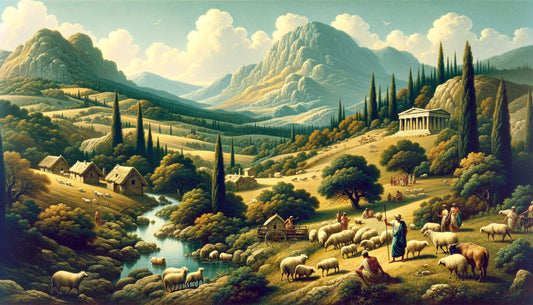
Before Olympia became synonymous with sport and competition, the place was already regarded as sacred. Its location was no coincidence: a fertile plain, surrounded by gentle hills, at the point where the River Alpheus meets the waters of the Cladeus. A setting ideal not only for human development, but also for divine presence. In the ancient world, nothing was founded by chance—for without the protection of the gods, there could be no future or prosperity.
This land was consecrated to Zeus, the supreme god of Olympus. However, the exact origin of the sanctuary is lost in time, and mythic tradition offers two main explanations—seemingly different, yet deeply complementary.
The first takes us to the tragedy of King Oenomaus, ruler of Pisa. The king had received a terrible prophecy: if his daughter Hippodamia were to marry, he would die at the hands of his son-in-law. To prevent this, he imposed a deadly challenge on all suitors: to win her hand, they had to defeat him in a chariot race. The punishment for failure was death. Oenomaus, confident in his advantage, possessed unmatched horses gifted by Ares, the god of war.
One by one, the suitors were defeated, until Pelops arrived—the hero who would give his name to the Peloponnese peninsula. Hippodamia fell in love with him at first sight and, fearful of his fate, conspired with Pelops to ensure his victory. According to the most widespread version of the tale, they sabotaged the king’s chariot by loosening the pin that held one of the wheels. The race began as usual, but midway through, the wheel came off, causing a fatal accident.

With the king’s death, the prophecy was fulfilled. Pelops won and married Hippodamia. But his victory came not without guilt or blood. To atone for this and honour the fallen king, Pelops instituted funeral games to be held periodically on that very spot. Over time, these games ceased to be a local tribute and became a sacred ritual under the gaze of Zeus.
The second tradition links the origin of the sanctuary to Heracles. During his fifth labour, the hero was sent to clean the stables of King Augeas—considered an impossible task. Augeas promised a reward if Heracles succeeded, but when the hero completed the feat by diverting the rivers, the king broke his word and banished him from the kingdom of Elis.
Years later, after completing all his labours, Heracles returned to Elis to avenge the betrayal. With Zeus’s help, he defeated Augeas and restored order. In gratitude to the god, and to consecrate the victory, Heracles founded a sanctuary dedicated to Zeus and established athletic games to honour strength, skill, and human excellence.
Whichever tradition came first, the ultimate meaning was the same: the Olympic Games were born as an act of tribute and reconciliation with the divine. Zeus became the centre of the sanctuary not only as god of the sky, but as the guarantor of order, justice, and oaths. Thus, Olympia became a place where human excellence held value only when exercised under divine law.
The Sacred Act of Competition
Over the centuries, the sanctuary continued to evolve. By the 8th century BC, the Olympic Games had already become a panhellenic event. Every four years, runners, wrestlers and charioteers would arrive in Olympia from every corner of the Greek world, crossing seas and mountains to present themselves before Zeus.
Before the games began, the ekecheiria, or sacred truce, was declared. Wars would cease, weapons fell silent, and the roads became safe. Not even the most irreconcilable enemies dared to break this ritual peace. During those days, Olympia stood above all human conflict, as a space where divine order prevailed over the violence of men.
The competition was not mere spectacle—it was a sacred act. Athletes competed naked, stripped of wealth and social rank, symbolising purity, equality and truth. In the eyes of Zeus, neither origin nor fortune mattered—only personal excellence. To win was not just to defeat an opponent, but to draw nearer to the gods through areté, the supreme virtue that combined physical strength, moral discipline, and self-mastery.
The victor received no material prize—only a crown of wild olive cut from Zeus’s sacred grove. But this modest gesture held deep significance: glory was not bought, but earned. Returning to one’s polis as an Olympic victor meant attaining near-heroic fame. Triumph made the athlete a role model for the community—someone who, like Heracles, had surpassed human limits under the watchful eyes of the gods.
Not all tales from Olympia, however, are glorious. There were also cheats, bribes and attempts to manipulate victory. Those caught were not only fined or expelled from the games—they suffered public humiliation. With the fines collected from the offenders, statues of Zeus were erected, known as the Zanes, lined up at the entrance to the stadium.
At the base of these statues, the names of the cheaters and the reason for their punishment were engraved. Before competing, athletes had to pass between these statues, reading the names of those who had dishonoured the games. It was a silent yet unyielding warning: in Olympia, to cheat was not merely to deceive a rival, but to offend Zeus himself.
Thus, competition became a test as much moral as physical. To win with honour elevated the man; to win through deceit condemned him to eternal shame. In this balance between glory and punishment, the Olympic Games reaffirmed their true purpose: to celebrate human excellence only when it upheld divine order.
The Earthly Presence of Zeus
By the 5th century BC, during a time of prosperity and splendour, the people of Elis commissioned the great sculptor Phidias to create a statue that would not only represent the god, but make him present within the temple. The result was a colossal masterpiece: Zeus seated on his throne, serene and omnipotent, almost touching the ceiling of the temple that housed him. His skin was of ivory, his robes and ornaments of gold; at his feet, the world seemed small and contained.
In his right hand, Zeus held Nike, the goddess of victory, as if to remind athletes that all human glory depended on his will. In his left, a sceptre crowned with an eagle affirmed his absolute dominion. This was not an angry or vengeful Zeus, but a just god—unchanging and watchful. The ancients said that if Zeus were to rise, the temple could not contain him: a powerful image of the disproportion between the divine and the human.

It is no surprise, then, that the great statue of Zeus was considered one of the Seven Wonders of the Ancient World. Not only for its size or precious materials, but because the Greeks believed Phidias had captured the very essence of divinity. Ancient writers claimed that those who beheld Zeus at Olympia left the temple moved, as if they had truly been seen by the god.
With this masterpiece, Olympia reached its peak. The Games, the sanctuary, and the image of Zeus formed an indivisible whole. There, human excellence met its limit, and the divine became visible. For centuries, this balance defined the deeper meaning of Olympia as the spiritual centre of the Greek world.
Memory Rediscovered
And yet, the great changes in humanity often bring about the death of its idols. With the end of the ancient world, silence fell over Olympia. Pagan cults were banned, the Games ceased, and the sanctuary was abandoned. The temples were left without voices, the statues without offerings, and the great image of Zeus, which had once dominated the heart of the site, disappeared forever. Time, earthquakes, and the floods of the Alpheios and Kladeos rivers claimed what mankind had left behind. Olympia was buried beneath layers of mud and forgetfulness.
For centuries, the place lived only in the memory of ancient texts. Pausanias, Strabo, and other authors described temples, statues, and rituals that no one could see anymore. Zeus still existed in words, but no longer in stone. The Games survived as a memory of a glorious past, but their physical stage had vanished from the visible world.
It was not until the 18th century that Olympia began to resurface. European travellers and scholars, fascinated by classical antiquity, attempted to locate the mythical site mentioned by ancient writers. But the definitive rediscovery came in the 19th century, when the first systematic excavations uncovered toppled temples, buried columns, and fragments of an immense sanctuary.
As the earth was removed, Olympia began to breathe again. The Temple of Zeus, the stadium, the gymnasium, the altars, and the offerings gradually emerged. The memory of the ancient Games, which had survived only in recollection and myth, was finally restored to the physical world.
Olympia reappeared not as a rebuilt city, but as a place of memory. Where Zeus is no longer worshipped, but still present. Where the Games are no longer held, but still echo. A space that can still be visited today—and brought back to life through the imagination.
A Flame That Never Dies
When the temples crumbled and the gods were no longer worshipped, one thing never truly vanished: the fire. In ancient Olympia, the sacred flame burned on the altars, a symbol of divine presence, of continuity, and of life. It wasn’t merely decorative —it was a direct link between mortals and gods, a light that reminded all that the world’s order had not disappeared, even if time erased everything else.
The Olympic flame, as we know it today, did not exist as a continuous ritual in the ancient Games, but its meaning did. Fire was consecrated to Zeus and, above all, to Hestia, guardian of the hearth and sacred centre. In that sense, the modern flame is not an invention but a reinterpretation —a flame of remembrance connecting the ancient world to the present.

When the flame is once again lit in Olympia and begins its journey to a new host city, what is passed on is not just fire, but a legacy. A silent message that says the Games do not belong to one place or time, but to an idea. The very idea that once halted wars, sealed oaths, and placed human glory under a higher law.
Today, Olympia is no longer just a plain between rivers or a collection of ruins. It’s part of our collective memory. Athletes from all over the world dream of being part of their own Olympia: the Olympic Games, held every four years in a major city of the modern world. There, they seek to touch glory—to touch the divine. Perhaps no longer to approach the gods, but to inscribe their name in the shared story of humanity.
Victory may no longer bring divine immortality, but it offers another form of eternity: remembrance. A memory that crosses borders, generations, and cultures. And as long as the flame continues to be lit—as long as someone runs, jumps, or competes with honour under its glow—Olympia will remain alive. Not as a place of the past, but as an idea that, like fire, never dies.