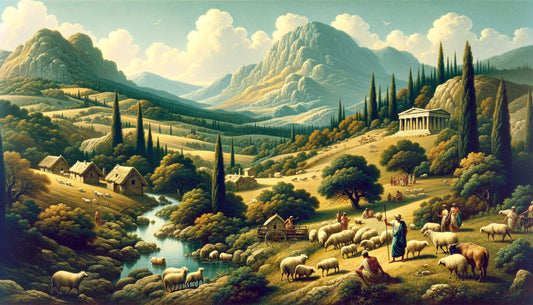

A Collective Procrastination: Lessons from Heracles’ Fifth Labour
It complements the story of the Augean Stables.
We have all done it at some point. Putting off until tomorrow something we should have faced long ago. A difficult conversation. A problem at work. A habit we know is harming us. At first, it seems insignificant. “I’ll deal with it later,” we tell ourselves.
But time passes, and what was once small begins to grow. It piles up, hardens, takes root. Until one day it is no longer a minor inconvenience, but a vast, heavy burden, almost impossible to confront.
This is how many of life’s greatest troubles begin: not with a single major mistake, but with the accumulation of countless small acts of neglect.
The stables of King Augeas were precisely that. Filled with divine cattle, worthy of royalty and meant to be admired, yet still cattle all the same, requiring care and cleaning. What must have started as a few days of neglect eventually became years without being cleaned. No one took responsibility, and the filth grew beyond measure. A chaos that troubled everyone… yet one that no one dared to face.
A serious nuisance turned into a monumental task, and with the limited time granted to Hercules, it became virtually impossible to complete. A challenge designed to break him.
A Human Superpower
To confront the problem, Hercules turns to what we might call the most important superpower of our species: creativity.
We do not have the teeth of a lion, the strength of a gorilla, or the speed of a cheetah. But we do possess something no other animal has to the same degree: the ability to imagine solutions to the great problems we face. Every time humanity has encountered a limit, creativity has provided the way forward. From the discovery of fire to the technological revolution. From the domestication of agriculture to the production of energy.
It is no coincidence, then, that humanity’s greatest ideas have emerged from creative intelligence. Those who cultivate it understand that profound change does not come from repeating the same actions over and over again. It is born from breaking patterns. From questioning what everyone else takes for granted.
Hercules, also known for his sharp mind, applies creativity not only to complete the task efficiently, but to do so in record time. Instead of fighting the problem head-on, he chooses to transform it. He does not rely on shovels or superhuman exertion. First, he observes his surroundings and notices the rivers flowing nearby. Then he makes an unconventional decision: to divert their course so that they pass through the stables.
The filth that seemed immovable is swept away by the force of the water. In just a few hours, what would have required weeks of labour is left completely clean.
But creativity alone was not enough. Hercules still needed one more, even more powerful ally.
The Great Sleeping Army
In the previous labour, when he captured the Erymanthian boar, Hercules had already learned to use the terrain to his advantage. This wisdom is far from new. Sun-Tzu, in The Art of War, warned that weather and nature can become a force multiplier—an invaluable strategic ally. A true sleeping army, ready to be awakened if one knows how to summon it.
It’s no coincidence, then, that humankind has used creativity to harness nature as a tool:
- The earth has allowed us to build, shape landscapes, and even extract geothermal energy.
- Fire has been the origin of human power and dominance: from warfare to energy production.
- Wind has carried us across seas with sails and turned mills for centuries.
- Water, channelled with ingenuity, has enabled irrigation, mechanics, and hydroelectric power.
All those natural elements have served us to extract energy. A tremendous force that can be our greatest ally—but one that also constantly reminds us it cannot be tamed: earthquakes, volcanoes, wildfires, hurricanes, floods, tsunamis. These are nature revealing its raw power.
Hercules understood this. He needed a force beyond his own to succeed. And he knew how to delegate the task to the unstoppable strength of the rivers.
Don’t fight alone when the world itself can fight for you.
Avoiding Greater Evils
The story of Augeas’ stables doesn’t just teach us to be strong. It teaches us to be wise. To keep our creativity alive in the face of adversity.
But it also confronts us with one of humanity’s greatest enemies: procrastination. Had the work been done when it should have been, such a drastic solution would never have been necessary.
Hercules was fortunate to be able to harness nature as an ally to solve the problem swiftly and effectively. But not every challenge in life will allow us to rely on such a powerful external force.
That’s why it’s worth remembering:
What you delay today will rule your tomorrow.
Don’t let it. Because great disasters rarely begin with great mistakes, but with small acts of neglect repeated over time.